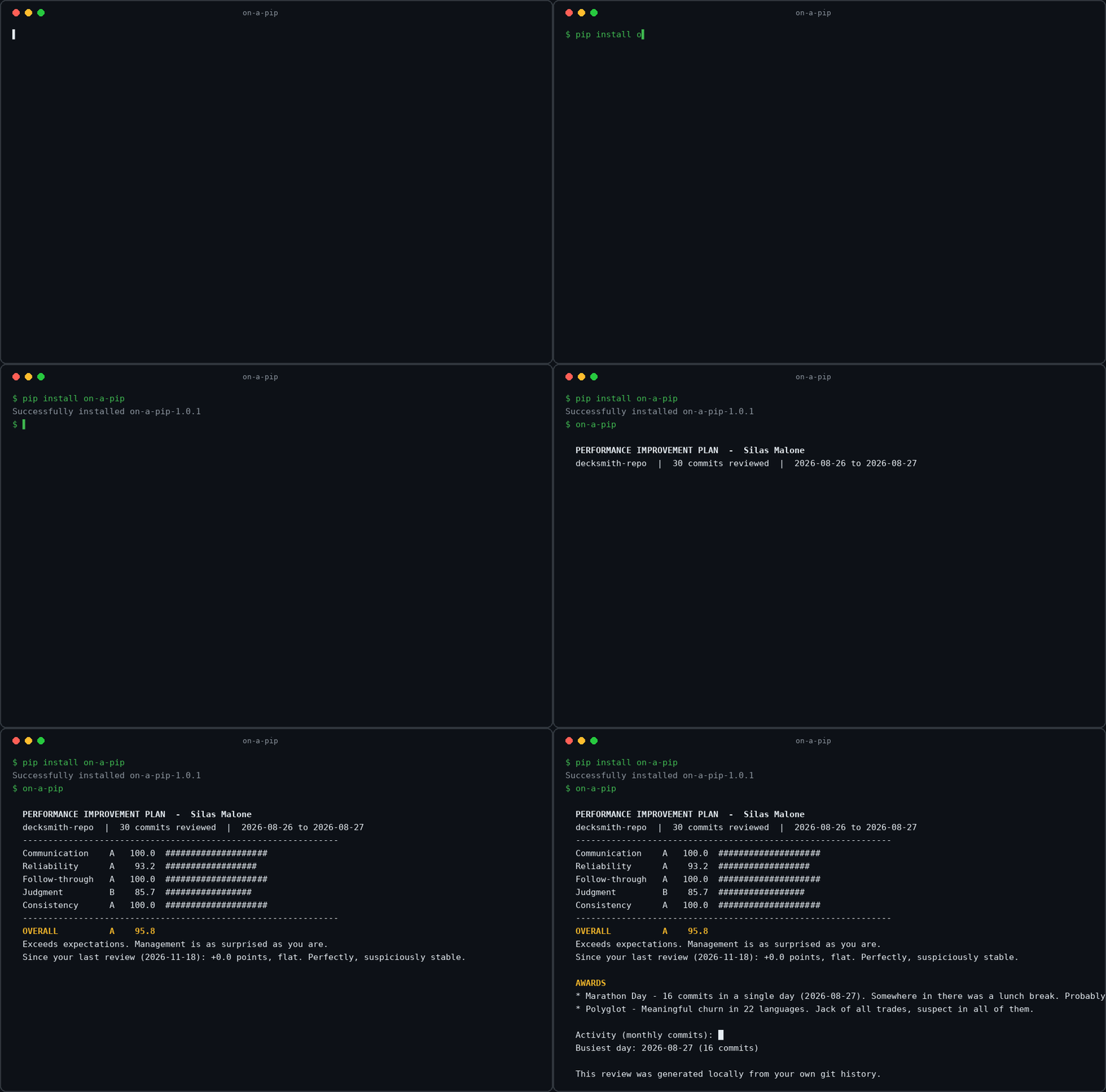
Every tool reviews your code. PIP reviews the programmer.
Every developer keeps a work diary without knowing it: their git history. PIP reads that record,
locally, on your own machine, and issues a formal manager-style performance review. Five graded categories,
evidence drawn from your own commits, 21 awards, shareable report cards, and a 30-day improvement plan.
A real review, rendered from the tool's actual output. No mockup.
What it grades
CommunicationHow many of your commit messages actually say anything. "stuff" and "wip" are entered into the record.
ReliabilityCommits between 10pm and 5am. Friday-after-4pm shipping. Reverts. Chains of "fix".
Follow-throughThe TODOs still sitting in your code, and how old the oldest one is. A 400-day TODO has seniority.
JudgmentThe spots labelled "temporary", "hack" or "workaround", and how long they have been load-bearing.
ConsistencyActive days versus silent stretches. Longest streak. Longest disappearance.
Then it writes you a 30-day improvement plan from your three weakest categories, and signs off with the
only appeal process that has ever worked: improve the record. Choose your manager: Corporate, Startup CTO,
Supportive Lead, Passive-Aggressive Middle Manager, Pirate Captain, or Noir Detective. The evidence never
changes. The tone absolutely does.
Famous projects, formally reviewed
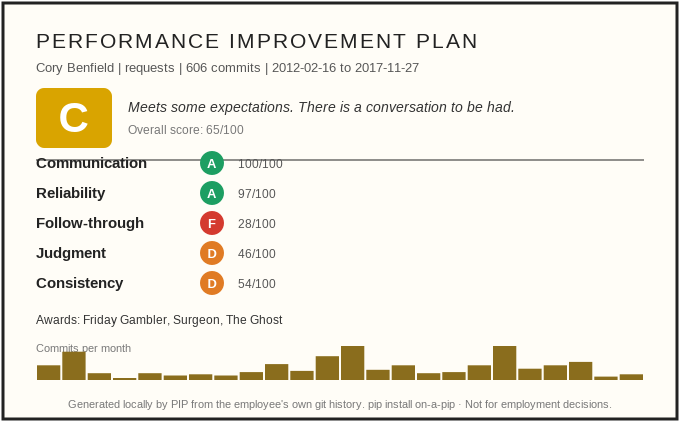
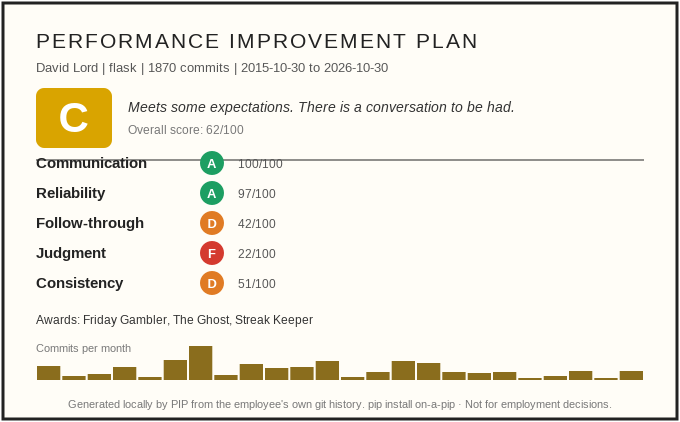
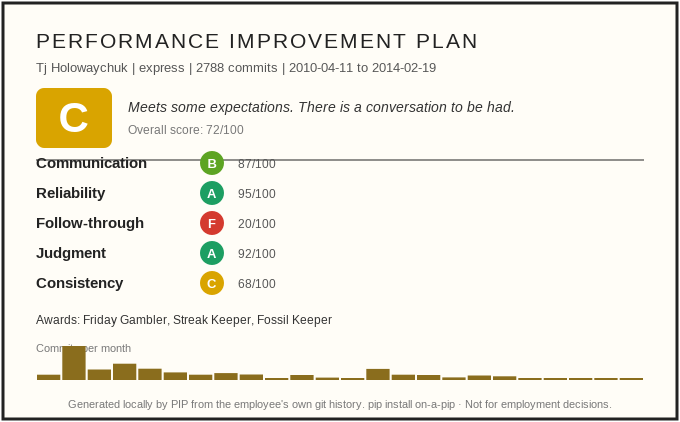
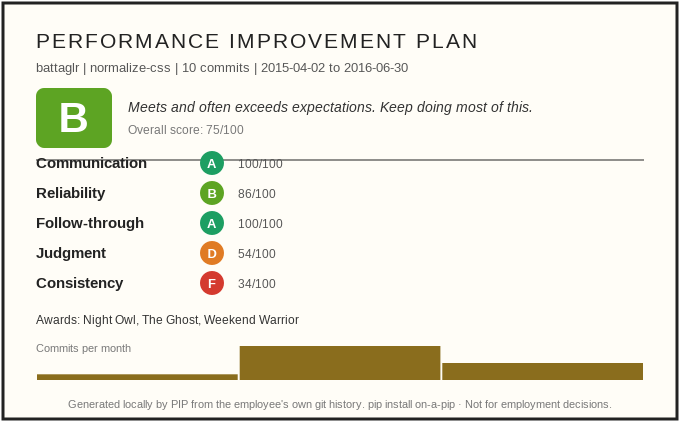
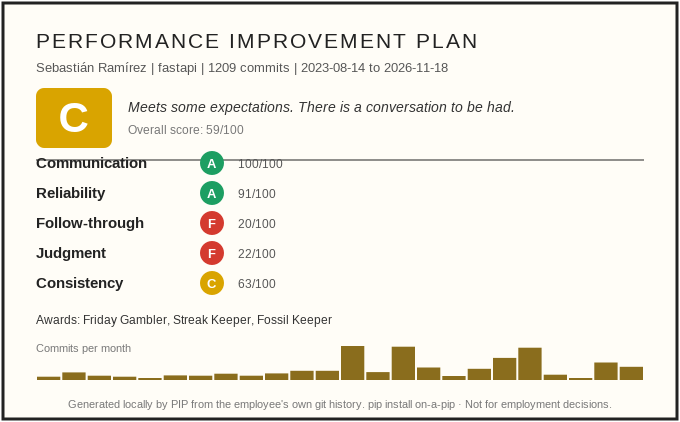
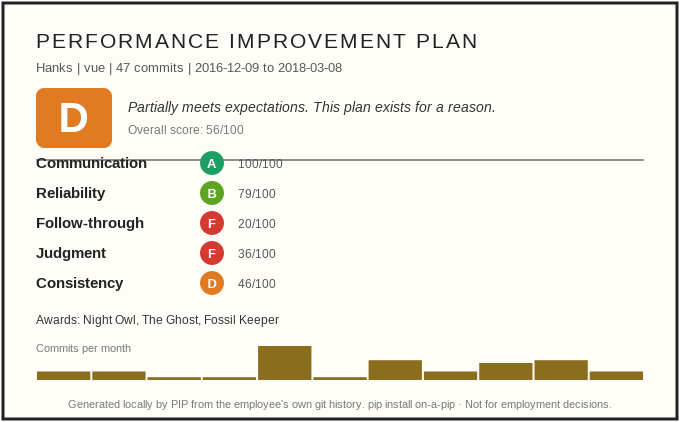
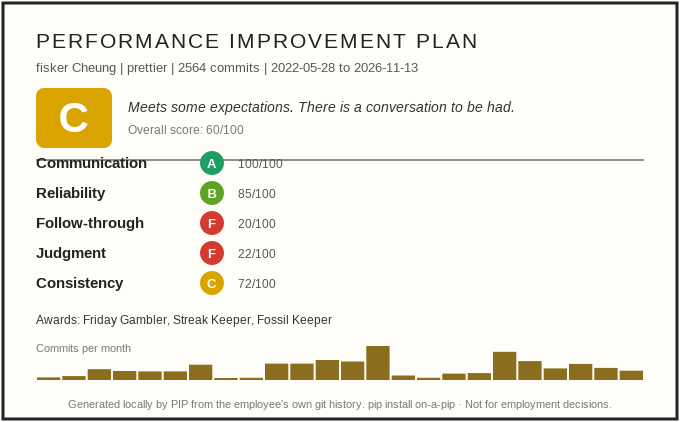
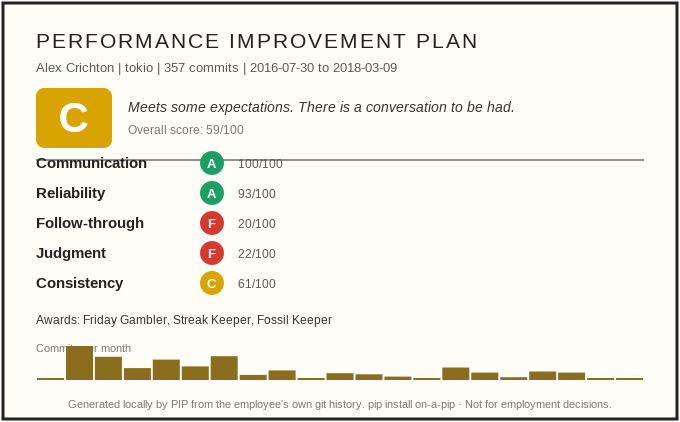
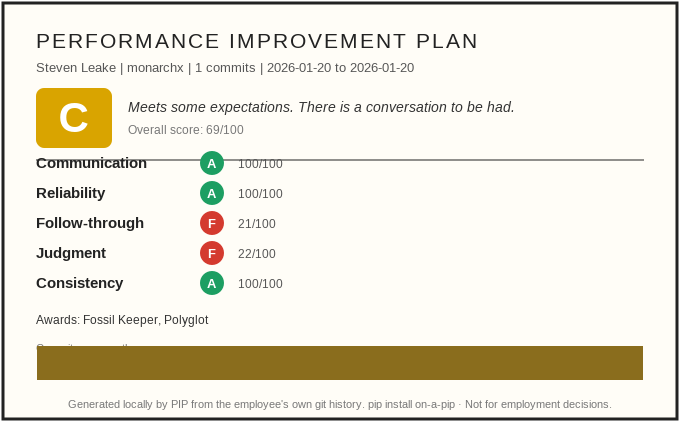
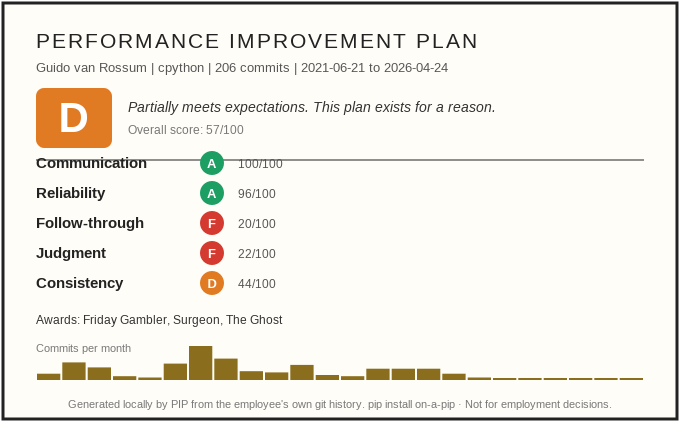
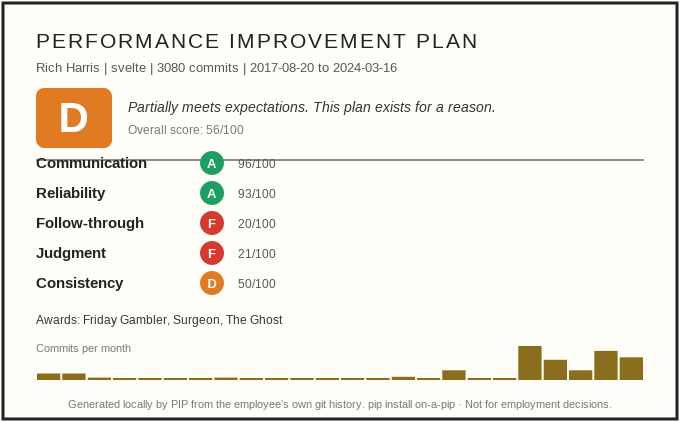
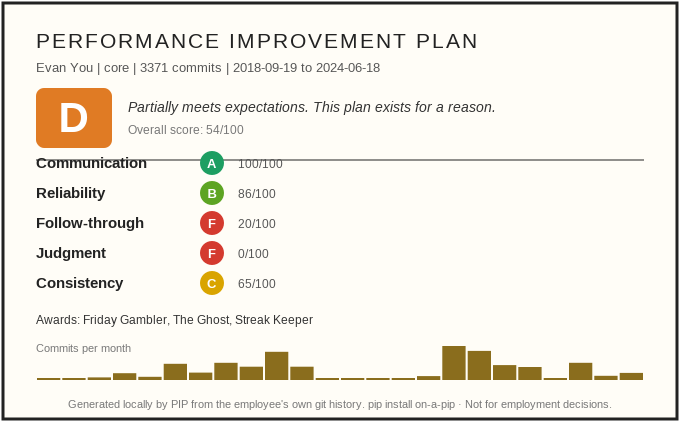
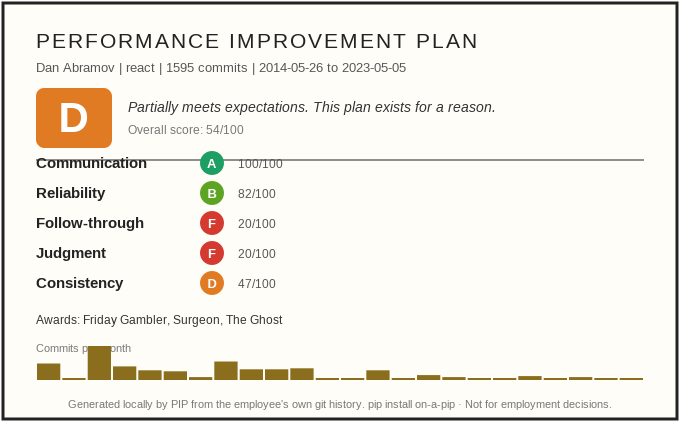
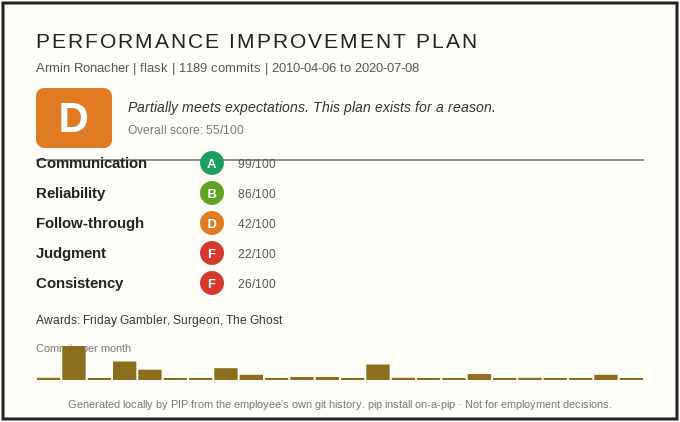
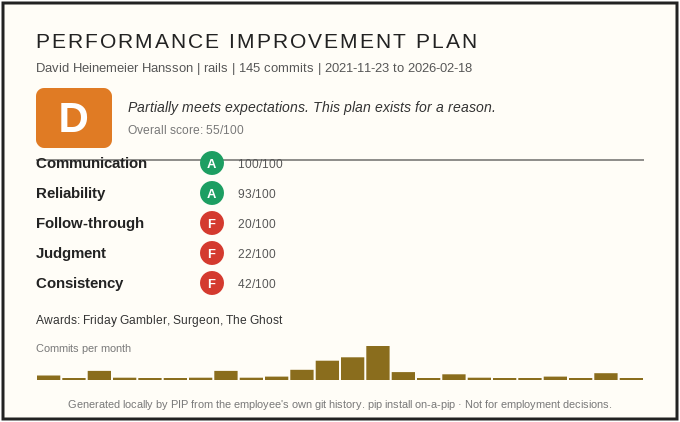
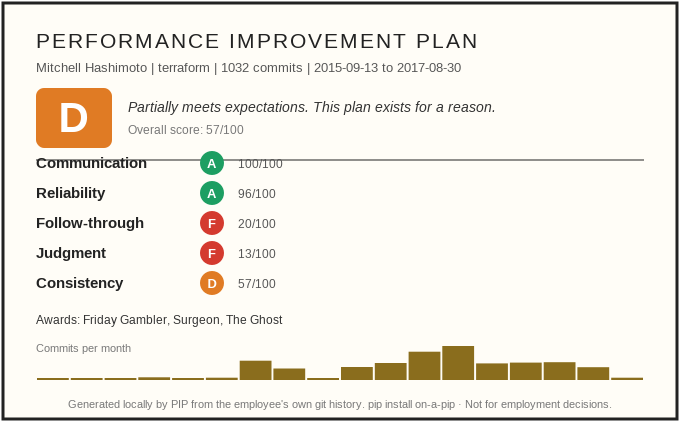
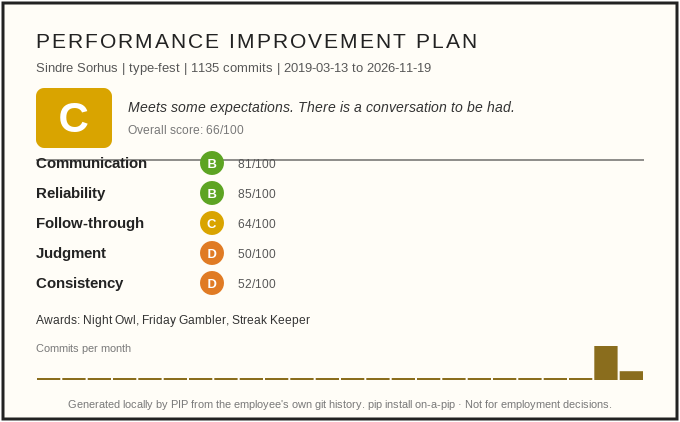
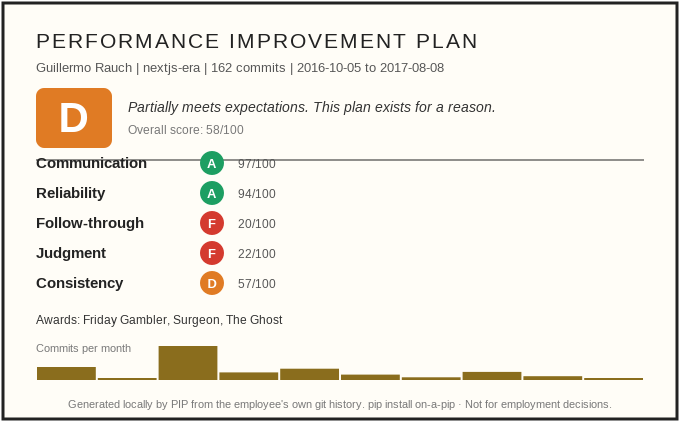
Requests. Its creator grades out at a D: Night Owl. His record splits into two rows (two email addresses, no mailmap to merge them). Top of the board: Cory Benfield, C 64.8.Flask. David Lord, C 62.4. The record is the record.Express. Tj Holowaychuk, C 72.3.normalize.css. battaglr, B 75.0. The only B in the gallery.FastAPI. Sebastián Ramírez, C 59.2, across 1,209 commits of his own record.Vue. The board is topped by a maintainer, Hanks, at a D 56.3. The creator's early record grades lower. The record is the record.Prettier. fisker Cheung, C 60, 2,564 commits reviewed.Tokio. Alex Crichton, C 59. PIP is language-agnostic: it reads git history, not code.Steven Leake. A community entry: his pinned repo is a fork; filtered to his own commits it holds exactly one, a README update. C 68.5. His own repos grade B, on 23 commits total.Guido van Rossum. Python's creator, on CPython's most recent 25,000 commits: D 56.6 across 206 commits of his own, 2021-2026. Communication A 100. The D is CPython's ancient TODOs talking.Rich Harris. Svelte's creator: D 56.0, 3,080 commits. Weekend Warrior: 45% of his commits land on a Saturday or Sunday.Evan You. Vue's creator, on Vue Core: D 54.3, 3,371 commits, Communication A 100. The old Vue repo grades him harsher (D 48.8).Dan Abramov. React and Redux: D 54.0, 1,595 commits, 2014-2023, including a 302-day disappearance in the record. The Ghost.Armin Ronacher. Flask's creator, reviewed by name with his identities merged: D 55.1, 1,189 commits, ten years on one codebase, and one 720-day disappearance.DHH. Rails' creator, on the repo's most recent 30,000 commits: D 55.4, 145 commits, 2021-2026. The window grades the chairman era, not 2004. One TODO in the tree is 5,896 days old.Mitchell Hashimoto. HashiCorp's co-founder, on Terraform: D 57.1, 1,032 commits, 2015-2017. The famous set's highest score, and its harshest Judgment grade (F 13.0).Sindre Sorhus. The only C in the famous set: C 66.3 on type-fest, 1,135 commits, including a 147-commit day in October 2026. His 10-repo org board runs from B 85.2 to F 30.6.Guillermo Rauch. Next.js's creator, graded on the framework's first year (2016-2017, era window to the v10 tag): D 58.0, 162 commits, the highest D in the set. In the repo's recent 8,000 commits he has no commits under his name at all.
Full reviews and leaderboards live in the gallery in the repo.
PIP reviewed its own author too: a B, with a Follow-through D, because the tool's own source contains the TODO markers it grades everyone else on.
Fair by default
Commit records are terrible evidence about people, so the grading is honest about it:
Bots are excluded by default. Dependabot does not need a performance review. (--include-bots if you disagree.)
Co-authors get credit from Co-authored-by trailers.
Lockfiles and minified files do not count as churn.
Squash-merge-heavy histories carry an authorship note: the grade belongs to whoever pressed the merge button.
Every review carries an authorship check: how much of the record is the reviewed author's own work, and a plain flag when the bulk of the history was inherited, as with a rebranded fork.
--tz Europe/Berlin grades in your timezone, not the server's.
NOT FOR EMPLOYMENT DECISIONS. PIP grades a commit record, not a person, and it reads best when the person reading it is the person who wrote the commits.
Private by construction
No AI. No models. No uploads, accounts, or telemetry. PIP is one Python file of plain arithmetic in the
standard library, so every grade can be traced back to the record that produced it. It runs git log,
git grep and git blame on your machine and nothing else. Your history is embarrassing
enough without uploading it somewhere.
Report cards, README badges, team leaderboards, head-to-head mode, coaching plans, single-file reviews,
org boards, authorship checks, and a Wrapped mode for your year in commits are all in the box.
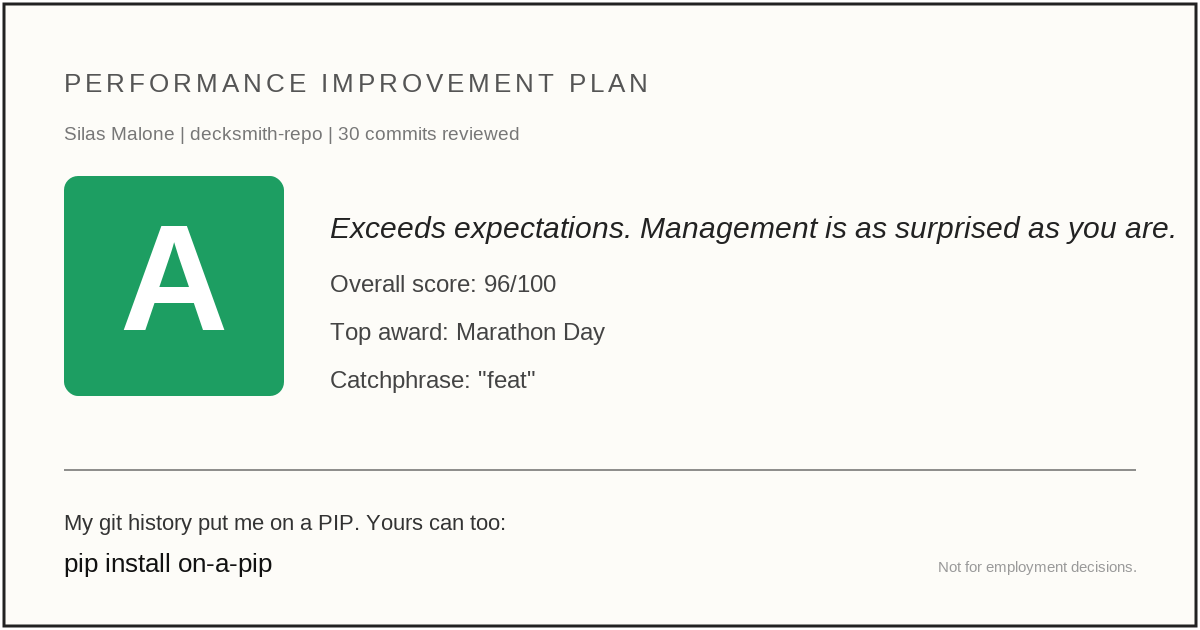
The 1200x630 share card (--share), sized for social posts.